
SpyderBot Documentation
Understand why your own AI answer differs from SpyderBot
You ask an AI system about your brand and see a different answer from the one in SpyderBot. That difference may reflect different conditions, variation between observations, or a problem that needs investigation.
This guide helps you distinguish those possibilities. It does not assume every mismatch is normal variation.
Your outcome: an explanation supported by the compared evidence, or a support packet that makes the discrepancy possible to investigate.
1. Identify what you are comparing
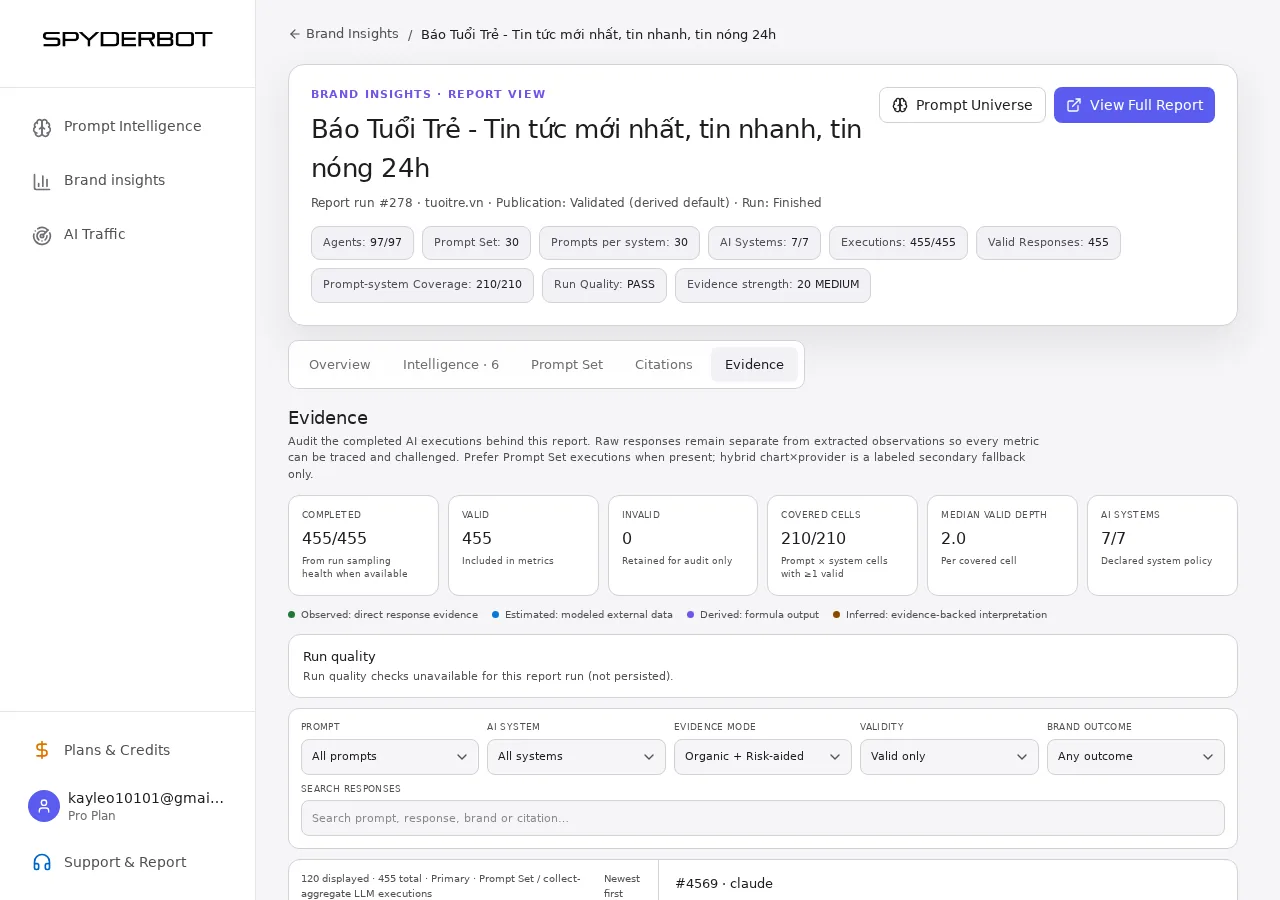
Open the relevant SpyderBot result and its underlying response evidence. Determine whether your personal answer is being compared with a single stored answer or an aggregate across multiple questions, systems, or observations.
An aggregate recommendation rate does not predict that every individual answer will recommend the brand. First find the specific response or scope relevant to your comparison.
2. Check the conditions you can verify
| Condition | What to compare |
|---|---|
| Exact wording | The executed question, including constraints and any brand names |
| Context | Product scope, language, market, and any supplied context visible in the evidence |
| AI system and surface | The actual system and experience used, rather than assuming similarly named products are identical |
| Time | The observation date and the date of your own query |
| Conversation | Whether your query followed earlier messages or used account-specific context |
| Tools or retrieval | Any visible differences in browsing, search, or other execution conditions |
For example, a Gemini conversation and a Google AI Overview are different experiences. Matching a vendor name is not enough to establish that the same surface was measured.
Record conditions that are unknown. You may not be able to reproduce the consumer product's personalization or hidden execution settings, and should not claim a fully matched experiment when you cannot verify them.
3. Check whether SpyderBot's interpretation matches its evidence
Read the stored response and compare it with the finding or extracted result. Focus on the disputed claim:
- Does the response actually mention the correct entity?
- Does it recommend the brand, or merely list it?
- Is the description positive, negative, qualified, or ambiguous in context?
- Does a displayed citation correspond to the cited material in the stored response?
If the stored response and interpretation disagree, preserve that example for support. The fact that AI answers vary does not explain an extraction or entity-matching error within the same observation.
4. Choose the appropriate conclusion
| What you find | Conclusion and next action |
|---|---|
| Your question names the brand; the measured discovery question does not | Different tasks were measured. Compare equivalent question types before judging the result. |
| Same broad question, but different surface, time, or conversational context | Conditions differ. Describe the difference and avoid treating the comparison as a reproduction. |
| Comparable visible conditions, different observed answers | Variation is possible; the available evidence may not identify its cause. Consider a focused observation if it would affect a decision. |
| Stored response does not support the extracted finding | Send the specific evidence mismatch to support. |
| Scope or execution metadata appears incorrect | Report the metadata issue with the relevant observation reference. |
| The available evidence cannot resolve the difference | Keep it unresolved; preserve the evidence instead of guessing. |
Illustrative example. You ask "Is Brand A a good choice for remote teams?" and receive a favorable answer. A SpyderBot discovery observation for "Which tools suit remote teams?" does not mention Brand A. These results are compatible: the first supplies the candidate, while the second tests whether AI introduces it.
In a different case, the stored answer says Brand A is unsuitable for the requirement while the extracted result labels it an active recommendation. That warrants an interpretation review, regardless of what your personal query returned.
5. Send a support packet that can be investigated
Use the available report or observation reference and the relevant support channel. Include:
Result reference: report, program, run, or observation link available to you.
Disputed finding: the metric, entity, or claim you believe is inconsistent.
Stored evidence: the exact response passage and question.
Your comparison: prompt, answer, system/surface, and date.
Conditions: known differences and details you could not verify.
Expected interpretation: explain why the evidence appears inconsistent; do not only state that the score looks wrong.
Remove private conversation content and credentials that are unrelated to the issue. Retain enough surrounding text to preserve the meaning of the claim.
Run another analysis only if it answers a defined question, such as whether a pattern persists under the intended scope. Repeatedly rerunning until one answer matches your expectation does not resolve the original discrepancy.
You are done when you can explain the observed condition difference, identify a support issue, or state precisely what remains unknown. A supported unresolved conclusion is better than attributing every mismatch to randomness.