
SpyderBot Documentation
Assess your brand as an alternative to competitors
A customer asks AI about a competitor. Does AI introduce your brand as a relevant alternative, and what reason does it give?
This is a different question from whether your brand appears in general category discovery. It helps identify the situations in which your product can credibly enter a customer's consideration after a competitor is already in view.
Your outcome: a current assessment of a competitor-led alternative-use case, its supported change over time when observations allow, and a decision to improve, preserve, investigate, or defer it.
1. Start from Competitive Capture observations
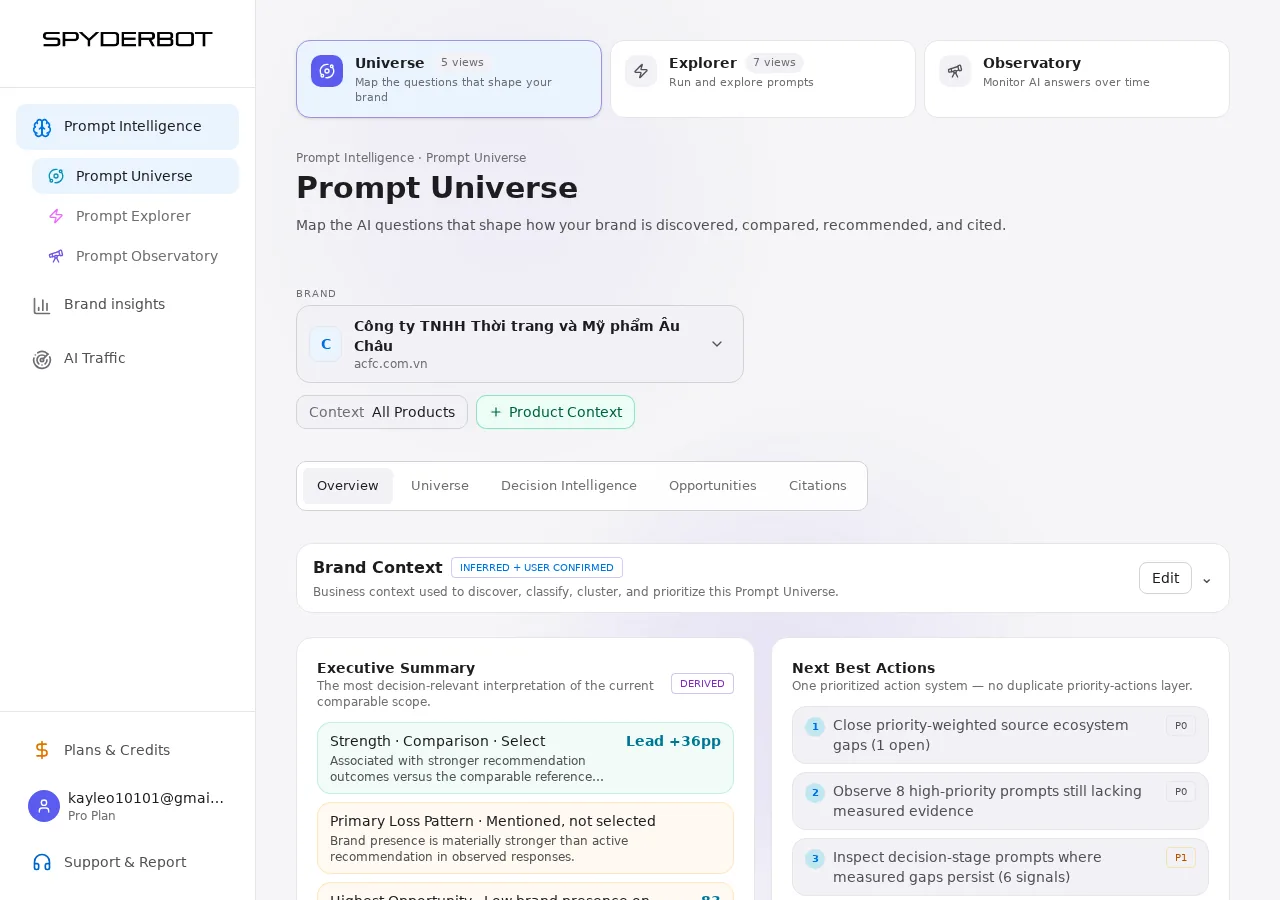
In your AI Visibility Benchmark within Universe, use the Competitive Capture measurement scope and select the relevant comparator. Review the proposed scope if you are setting it up for the first time, then start observing. You need actual observations before interpreting capture.
Choose a competitor that serves the audience and use case you want to assess. Keep market, language, AI systems, and observation scope visible.
If your question is simply "Who is recommended for this category?", use the general competitor-gap playbook. This article concerns questions anchored on a competitor.
2. Check the direction and wording of the questions
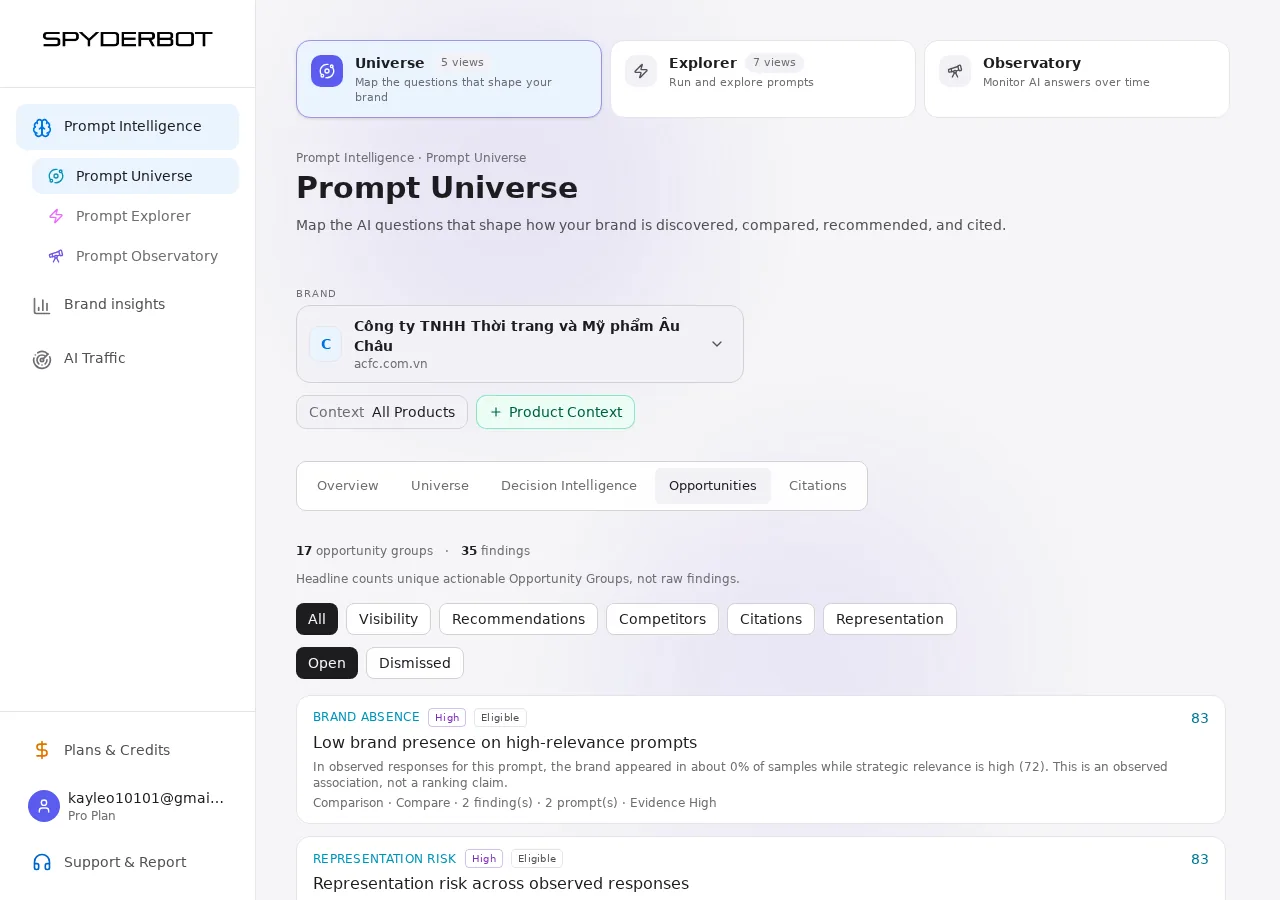
Read the actual questions behind the result. You need to distinguish whether AI introduced your brand independently or the question explicitly asked it to discuss your brand.
| Question situation | What you can learn |
|---|---|
| A competitor is named; your brand is not supplied | Whether AI brings your brand into consideration in that competitor-led situation |
| Both brands are named | How AI compares the supplied candidates |
| Your brand is named and the competitor appears | The reverse direction; do not treat it as equivalent capture for your brand |
| No brand is named | General discovery or recommendation behavior |
Use SpyderBot's designated measurement scope rather than manually mixing these question types into one rate. If the prompt already supplies your brand, do not interpret its later appearance as independent introduction.
Capture is directional. Your brand appearing when a competitor is discussed does not imply that the competitor appears at the same rate when your brand is discussed.
3. Inspect how the alternative is presented
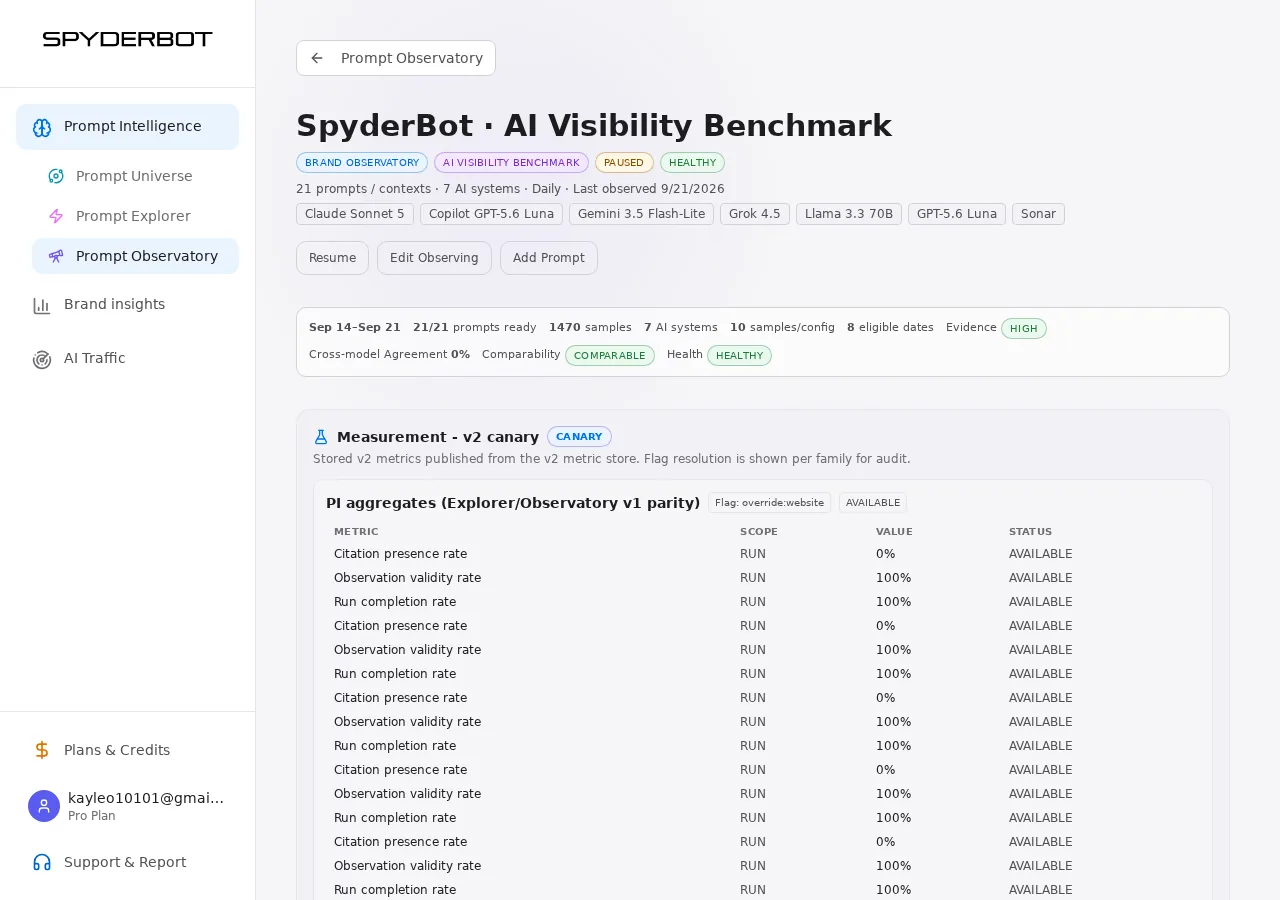
Start from the benchmark finding, then inspect the responses supporting a relevant use case. Determine whether your brand is merely mentioned, listed as an alternative, or actively recommended under a condition.
Look for the reason: a different price structure, simpler deployment, a required integration, geographic availability, or suitability for a particular team. Verify material claims against current product facts.
If the answer only says both brands exist, the next task is not automatically a comparison landing page. Determine whether there is a meaningful customer requirement your product can support and explain.
4. Choose the use case worth investing in
| What you observe and verify | Decision |
|---|---|
| Your brand is recommended for a genuine strength relevant to your target audience | Make the supporting information accurate, clear, and easy to evaluate. |
| Your brand appears, but the claimed advantage is incorrect | Correct the information; do not amplify a favorable false claim. |
| A relevant advantage exists but is poorly explained | Prepare a focused content or positioning task. |
| The competitor meets a requirement your product cannot satisfy | Do not manufacture an alternative claim; review audience fit or product priorities. |
| Observations are missing or too narrow | Gather evidence for the specific unanswered question. |
An unfavorable result in an irrelevant use case need not become a task. Focus on situations in which your brand is a credible choice.
5. Turn the opportunity into a useful asset or decision
Illustrative example. A support-software brand appears in answers about alternatives to a competitor for small multilingual teams. Some responses recommend it for quick setup. The team verifies that quick setup is supported, but finds that language availability depends on the feature.
It prepares a guide explaining setup requirements and the actual language coverage. It includes conditions rather than publishing "fully multilingual" as an unrestricted claim. The objective is to help a customer evaluate fit accurately.
Competitor-led need: an alternative for a small multilingual support team.
Observed behavior: our brand is introduced and sometimes recommended for setup simplicity.
Verified fit: approved setup capability and feature-specific language coverage.
Action: clarify the evidence and limits on the relevant product asset.
Later check: comparable capture observations and the accuracy of the stated rationale.
6. Review current capture and change in the same direction
Read the current Competitive Capture result for the selected comparator, then use the available comparable observations in the linked Observatory program or supported benchmark detail to assess change. Confirm the actual dates and the direction: competitor-led questions bringing your brand into consideration. Do not assume a dedicated capture trend chart exists in the compact benchmark.
Keep question scope, systems, competitor direction, and evidence eligibility consistent. Selecting a different comparator changes the view; it does not justify comparing the new competitor's current result with the old competitor's earlier result as one trend. If the underlying benchmark membership changes, review the supported comparison boundary.
| Pattern | Interpretation to verify | Next action |
|---|---|---|
| Capture increases and the stated rationale is accurate | Your brand is entering consideration more often in this measured direction | Preserve supporting information; investigate a relevant adjacent use case. |
| Capture increases but claims are incorrect | More introductions may amplify misleading information | Correct the claim before promoting the apparent win. |
| Capture falls in a relevant requirement | The brand enters the answer less often in that scope | Inspect before-and-after evidence and competing fit claims. |
| Introductions persist but active recommendations weaken | Being listed and being preferred may be moving differently | Investigate the stated selection criteria. |
| Your brand appears when the competitor is named, but the reverse pattern differs | The association is directional | Report both directions separately if both are measured. |
| Only one eligible observation exists | You have a current result, not an established change | Retain it as a baseline and review future eligible observations. |
Use the system's change or question-level intelligence to select evidence that could change the task. Do not rebuild capture from a handpicked set of favorable answers. For deeper diagnosis, use Investigate a change in your AI visibility while retaining the capture measurement context.
Illustrative continuation. After the support-software team clarifies language coverage, later answers describe the conditions accurately, but the brand is introduced less often in the selected competitor-led questions. The team records improved factual portrayal and weaker capture as separate observations. It investigates the remaining fit criteria rather than concluding that accurate information should be reversed to restore a favorable result.
Competitive Capture observes AI answers. It does not establish that a customer switched products, that a competitor lost a sale, or that revenue moved to your brand.
You are done when you can describe current capture in the intended direction, distinguish observed change from missing history, and select a supported action or review condition for the use case.
Next: use Turn an AI visibility opportunity into a content brief to assign the asset, or Monitor the questions and changes that matter to follow the use case.