
SpyderBot Documentation
Track your AI visibility and competitive position over time
Your visibility result has changed. Is your brand becoming more visible, catching up with a competitor, or improving in questions that do not matter to your current business?
Use this playbook for a recurring review of your AI Visibility Benchmark. Start with the latest intelligence, then investigate only the change or gap that could affect your next decision.
Your outcome: a scoped assessment of your current position, the meaningful change since a comparable observation, and one justified next action.
Choose the question you need to answer
| Your question | Inspect first |
|---|---|
| "Are we more visible than before?" | Your brand's AI Visibility Over Time within the same benchmark scope |
| "Are we catching up with our competitor?" | Visibility Gap Over Time, with a fixed selected competitor |
| "Where should we investigate next?" | Current Gap Breakdown and the relevant recommendations |
| "Why did the result move?" | The relevant change in Observatory and its supporting evidence |
You need an observed benchmark. If it is configured but has no eligible observation, start or resolve observation first. One valid observation establishes current position; a comparable earlier observation is needed to assess change.
1. Confirm what this benchmark represents
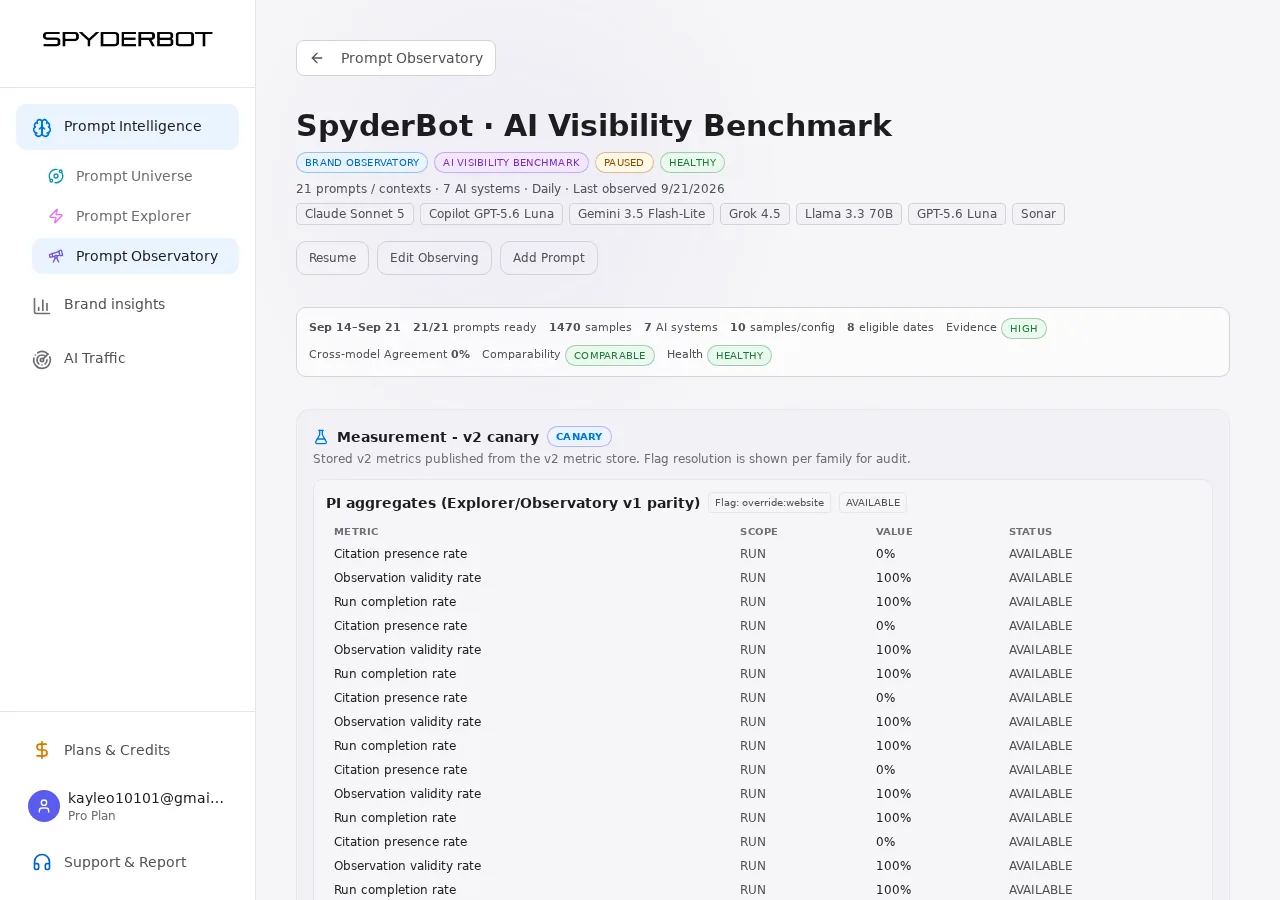
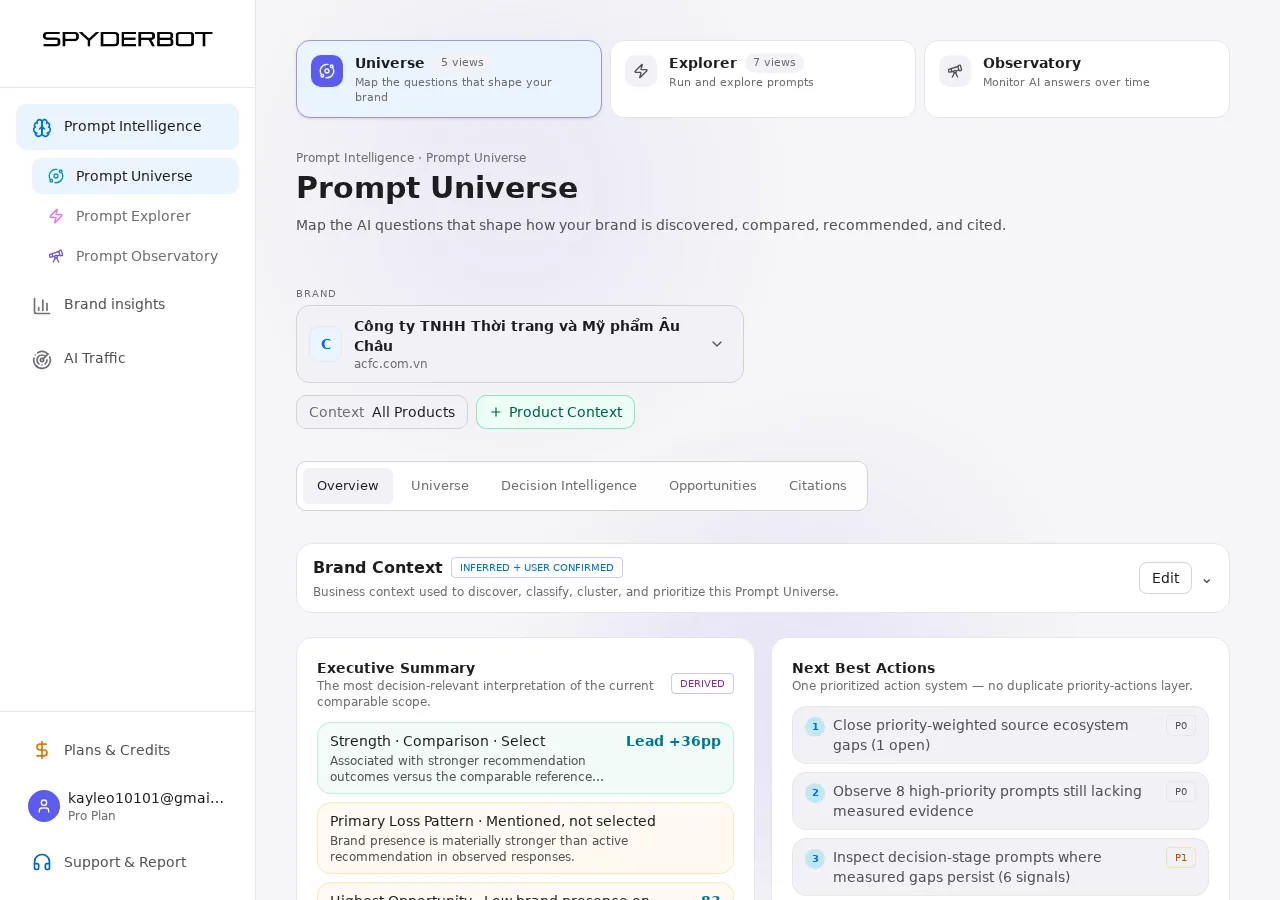
Open the AI Visibility Benchmark in Universe. Confirm the Context, discovery question scope, selected AI systems, and observation dates. Choose the competitor relevant to your decision and keep that identity fixed while reading the displayed history.
AI Visibility here concerns the eligible discovery scope. Keep brand-named understanding questions and competitor-led capture questions in their own measurement contexts. Use the metric's displayed definition; do not treat a visibility result as an interchangeable recommendation rate.
Review coverage when it affects the conclusion. If a selected system has no eligible observation on a date, that date is missing for the selected scope. An all-system result cannot fill that gap.
2. Read current position and historical movement separately
Start with the current result and What Changed?. Check the actual comparison dates. The summary compares eligible observations; it does not necessarily compare today with yesterday.
Then inspect AI Visibility Over Time for the business question you are reviewing. A selected-window change and the latest-observation change can differ because they use different endpoints. Read the labels before interpreting the direction. Two comparable points establish a difference; use additional eligible observations and the available persistence evidence before calling that difference a sustained trend. A missing date is not a zero or proof that the previous value continued unchanged.
Use Visibility Gap Over Time to understand relative position. A narrowing deficit can result from your improvement, a competitor's decline, or both. A widening lead is favorable for relative position even though the gap is moving farther from parity. Always identify which side of parity your brand is on.
| Pattern in comparable observations | Useful interpretation | Next decision |
|---|---|---|
| Your visibility rises and your deficit narrows | Absolute and relative position both improve | Inspect the relevant strengths or needs worth preserving. |
| Your visibility rises but your deficit widens | You improved, but the selected competitor improved more | Investigate the needs where the competitor is pulling ahead. |
| Your visibility falls but your deficit narrows | Relative position improved because the competitor fell further | Investigate your own decline before calling this a success. |
| You remain ahead and your lead widens | Relative position improves | Check whether the advantage concerns a priority customer need. |
| Your overall result is stable | Important segments may still move in opposite directions | Open a breakdown only if a meaningful finding or business question warrants it. |
3. Find the customer need that changes your decision
Use Current Gap Breakdown by intent, AI system, or cluster to locate the latest comparable gap. Start with a need your product serves and your team can act on. Use the system's opportunity or explanation as the starting point.
This breakdown describes current position; it does not prove that the selected segment caused the historical movement. To investigate a change, follow the relevant Observatory change and its supported breakdowns. Use Investigate a change in your AI visibility when that diagnosis is needed.
If selecting a segment offers a drilldown to the relevant questions, use it. Check that the destination preserves the intended scope. Otherwise open the relevant question evidence through the available list; do not assume a chart click has filtered everything automatically.
4. Turn the finding into an action
Inspect response evidence when it could change the task. Determine whether the brand is absent, mentioned without recommendation, described incorrectly, or less suitable for a stated requirement.
| Evidence behind the gap | Next step |
|---|---|
| Your brand is absent and the reason is unclear | Use Find out why your brand is missing from AI answers. |
| A competitor is preferred for a relevant requirement | Use the competitive-gap playbook. |
| A capability or limitation is described inaccurately | Verify the fact and use the portrayal playbook. |
| A supported advantage is growing | Preserve the accurate supporting information; evaluate a bounded related opportunity. |
| Evidence is too limited or the scope changed | Resolve coverage or scope before assigning performance work. |
If no finding warrants action, retain the current program and set the next review around your operating schedule. A routine review does not have to produce a new task.
Example: improvement that still leaves a competitive problem
Illustrative example; values are invented to explain the decision. A brand's visibility rises from 30% to 35% between comparable observations. Its selected competitor rises from 45% to 55%. The brand improved, but its deficit widened from 15 to 20 percentage points. The increase from 30% to 35% is 5 percentage points; do not label it a 5% relative increase.
The current breakdown shows a relevant gap in selection questions. Responses favor the competitor for a requirement the brand also meets, but describe the brand's capability incorrectly. The team verifies the fact and assigns a targeted information correction. It does not commission a broad site rewrite or claim that the current breakdown proves the cause of the historical change.
Finish the review with a short decision
Current position: result and competitor in the stated scope.
Change: own visibility and relative gap, with actual comparison dates.
Priority finding: the need or segment worth attention and its evidence.
Next action: investigate, improve, preserve, or monitor.
Owner and checkpoint: who follows up and what evidence will be reviewed.
Keep links to the existing results rather than rebuilding the dashboard in a spreadsheet.
You are done when you can explain current position and change separately, and choose a next step supported by the relevant evidence. If website results are not moving with visibility, continue to Investigate when AI visibility improves but traffic or leads do not.