
SpyderBot Documentation
Track citations and changes in the sources behind AI answers
AI answers cite different pages or publishers from one observation to another. Your website may gain citations, lose them, or remain absent while third-party sources describe your brand. Which changes deserve attention?
Your outcome: a supported source change or current source gap, with a specific page, content item, or publisher to investigate and a feasible next action.
1. Decide which citation question you are asking
| Your question | Relevant evidence |
|---|---|
| "Is our website being cited?" | Observed citations to owned pages in the selected answer scope |
| "What information is cited when AI answers these customer questions?" | The full observed source mix, including competitor and third-party sources |
| "Did a source change alongside a portrayal or recommendation change?" | Comparable response/source evidence linked to the change |
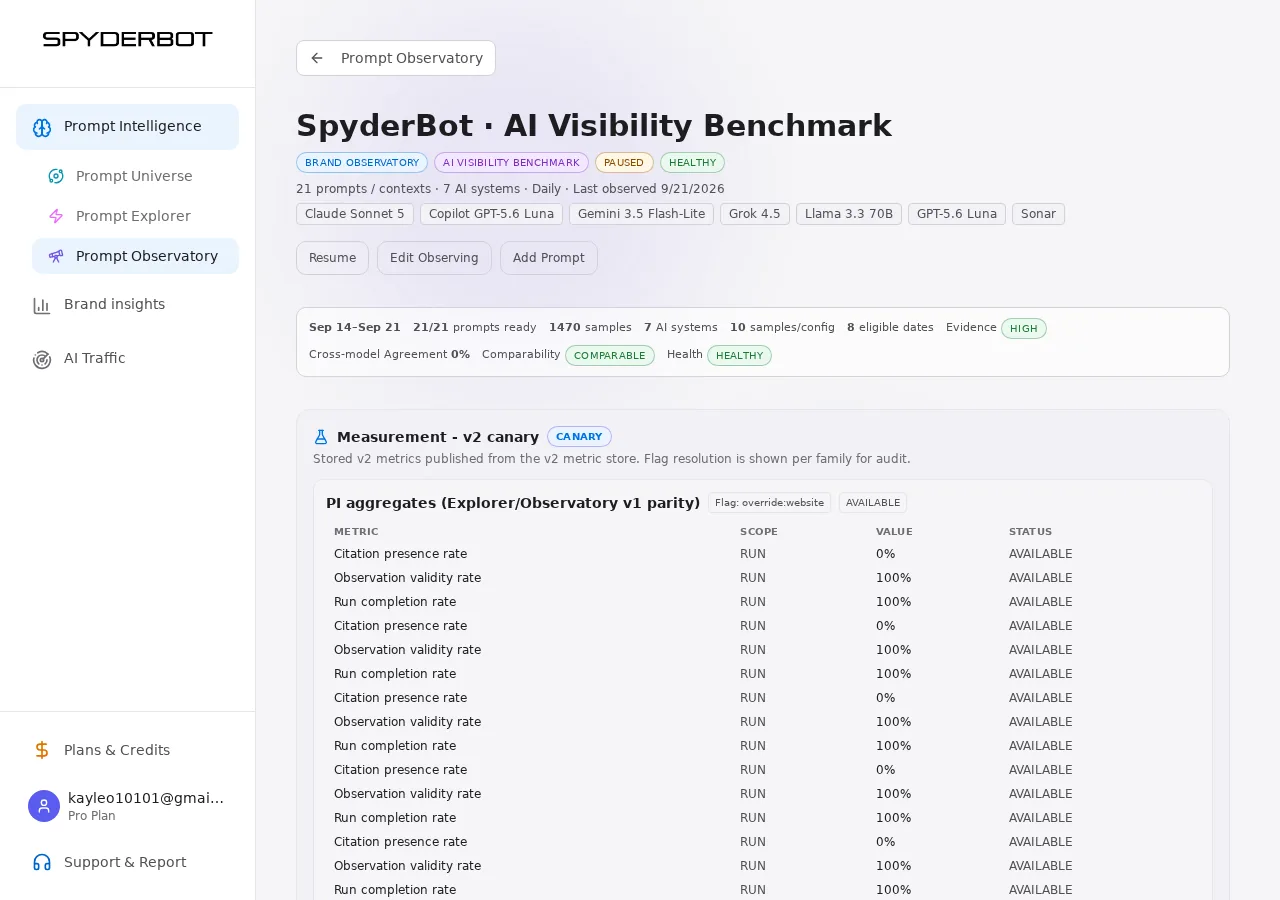
Start from the benchmark question, gap, or observation that matters. Follow the available source-evidence link into Citations or the relevant Observatory Sources and Evidence views. Confirm that the Context, questions, systems, and period match the task.
Benchmark observations supply source evidence; source analysis belongs in the relevant citation/source views. Do not assume that every citation breakdown or historical comparison appears as a separate chart in the compact benchmark.
2. Read the current source intelligence
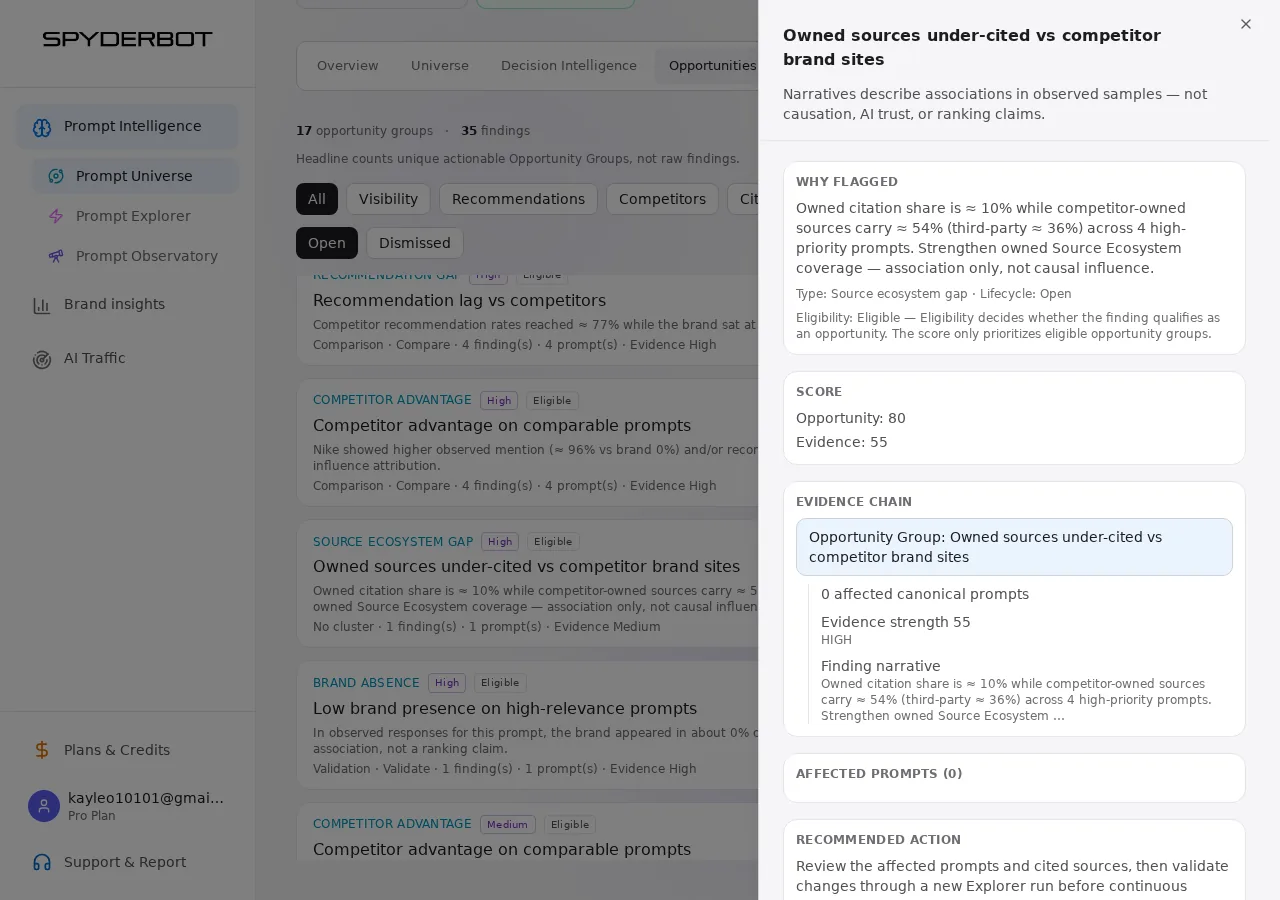
Review the available ecosystem summary, source-gap opportunity, or source finding before inspecting individual URLs. Determine whether the pattern concerns owned content, competitors, third-party publishers, a platform, or a particular content type.
Inspect a specific content item behind the pattern. A large platform domain is rarely enough to assign a useful task. Identify the relevant page, video, review, or discussion and the customer need it addresses.
Check content-access status before interpreting the source's wording. An observed citation establishes that the source appeared in the answer. It does not prove that the full source was accessible to SpyderBot or that every claim in the answer is supported by that source.
3. Compare actual observations
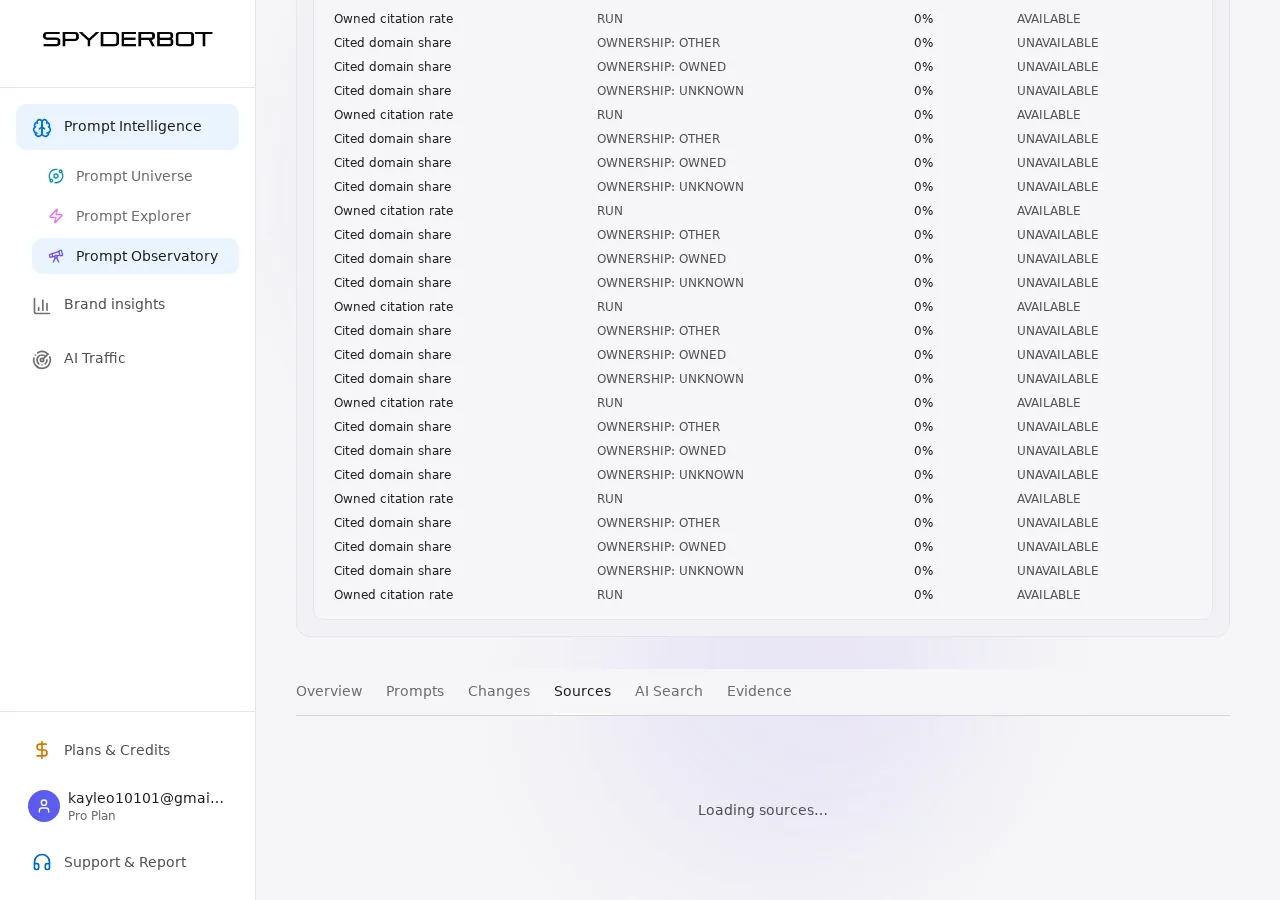
Use a supported source-change view when available, or inspect the source evidence from two comparable observations. Check questions, systems, dates, and observation coverage before describing a gain or loss.
If a citation metric is shown, read its definition and denominator. A cited-answer share, a count of citation occurrences, and a count of unique URLs are different measures. A larger raw count can result from more executions, multiple links in one answer, or broader coverage. Use the same measure and supported comparison scope across observations; do not convert a source list into an unofficial citation rate.
A page not appearing in one later answer does not establish that AI stopped using it generally. Describe the absence within the observed scope.
Distinguish three different changes:
- Citation appearance: whether an item appears in the observed answers.
- Source mix: which ownership types, channels, or publishers appear in the selected scope.
- Source content: what the inspected item says about the brand or need.
Historical citation evidence does not necessarily preserve the old page contents. If you only have the current page, do not claim its text changed between observations without suitable historical content evidence. Note redirects or URL variants when they could make one item appear to be two different sources.
4. Decide what the change means for your work
| Observation | What to verify | Next action |
|---|---|---|
| An owned page is no longer cited in the selected evidence | Scope, repeated evidence, URL variants, and the page's current state | Investigate the specific gap; run a technical check only when justified. |
| A new third-party source carries an inaccurate claim | The accessible source passage and current product facts | Prepare a factual correction request and align owned information. |
| A competitor source recurs around a relevant requirement | What useful information it supplies and whether your product meets the need | Review your supporting asset or product fit. |
| Relevant owned citations increase | Which pages and customer needs account for the pattern | Preserve accurate content; evaluate a related supported opportunity. |
| Visibility improves while owned citations decline | Whether other sources support the answers, and what goal owned citations served | Assess the actual customer or business objective before calling the change harmful. |
| Citation evidence becomes unavailable | Collection/observation state and source access | Resolve measurement or limit the conclusion. |
Citation presence is not automatically favorable. A cited source can carry an outdated or unfavorable statement. Inspect the portrayal that matters to your decision.
Example: a source change reveals a factual task
Illustrative example. Later observations for a retailer's returns questions cite a third-party guide instead of an owned policy page. The guide describes an outdated return window. The team verifies the current policy and confirms that the guide actually contains the old statement.
It checks the owned policy for clarity and prepares a correction request to the guide's publisher. It does not conclude that the guide caused a recommendation decline or that the owned page is blocked merely because its citation disappeared from the selected answers.
5. Record a source decision you can follow through
Scope and dates: the customer need, systems, and compared observations.
Observed change: citation appearance, mix, or verified content change.
Why it matters: the customer decision or inaccurate claim affected.
Task and control: owned update, external request, investigation, or monitoring.
Checkpoint: asset accuracy first; later citation and response evidence separately.
If you have only one eligible observation, finish with a current source assessment and a future review plan. Do not manufacture a history.
You are done when the source pattern has a clear interpretation and a feasible next step. Continue with Choose which sources and channels to improve first when several potential source tasks compete for your team's attention.