
SpyderBot Documentation
Investigate a change in your AI visibility
An alert or observation shows that your visibility, recommendations, portrayal, or citations have changed. You need to know whether the movement matters, where it occurred, and what action the evidence supports.
Your outcome: a short change assessment that identifies the affected scope, the supported explanation or remaining uncertainty, and the next action.
Fast route: open the relevant change, confirm comparability, identify its affected scope, and choose one next action. If the result is missing rather than changed, use Resolve missing or insufficient evidence first.
1. Open the change that matters to your decision
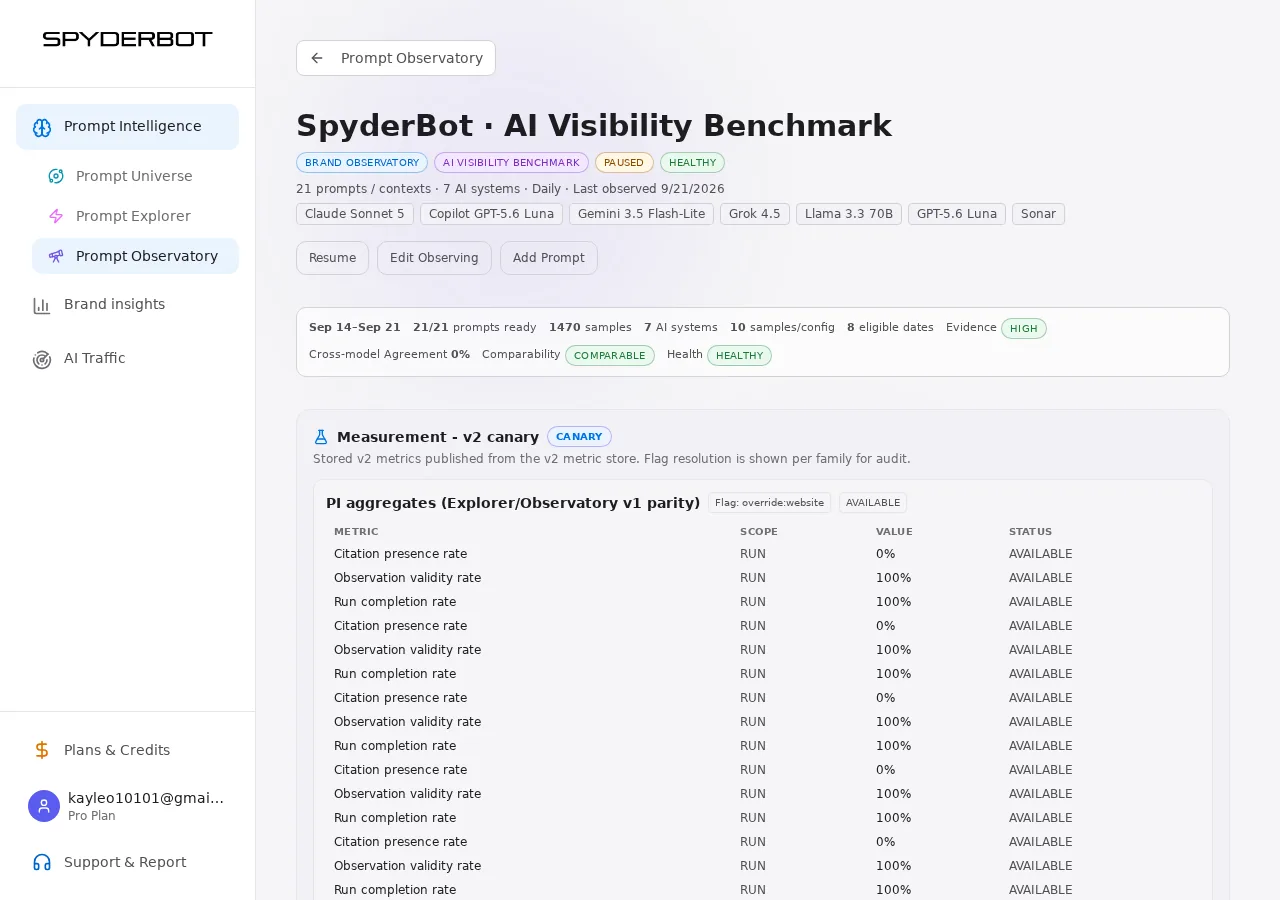
Start with the Intelligence Brief or Changes in Observatory. Select a finding relevant to an audience, requirement, or competitor you care about. Read the system's summary before opening individual responses.
Confirm what changed: the metric or portrayal attribute, the compared observations, and the reported direction. A favorable change also deserves review when you need to decide what to preserve or expand.
2. Check that the change is interpretable
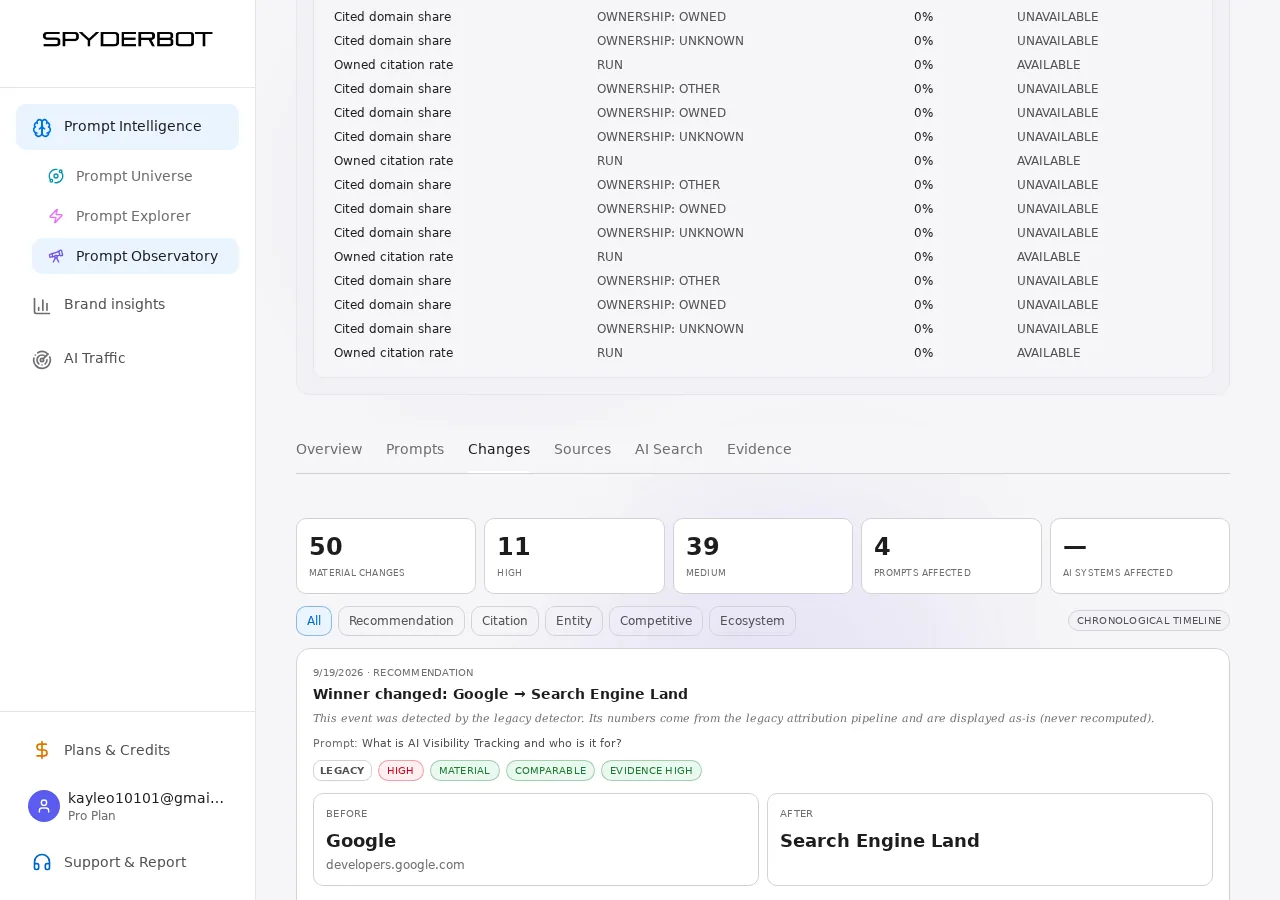
Review health, coverage, and any comparison limitations. Check for changes to the question set, Context, AI systems, or metric interpretation.
| What you find | Response |
|---|---|
| Comparable observations with adequate relevant evidence | Continue to scope and drivers. |
| A missing or failed observation | Investigate monitoring health. |
| A material scope change | Use a supported comparison if available; otherwise mark the break. |
| Too little evidence to judge the movement | Identify the missing observation and keep the conclusion open. |
A scope break may explain a changed aggregate without establishing a change in AI behavior. Keep the periods separate when the product cannot support a valid comparison.
3. Locate where the movement is concentrated
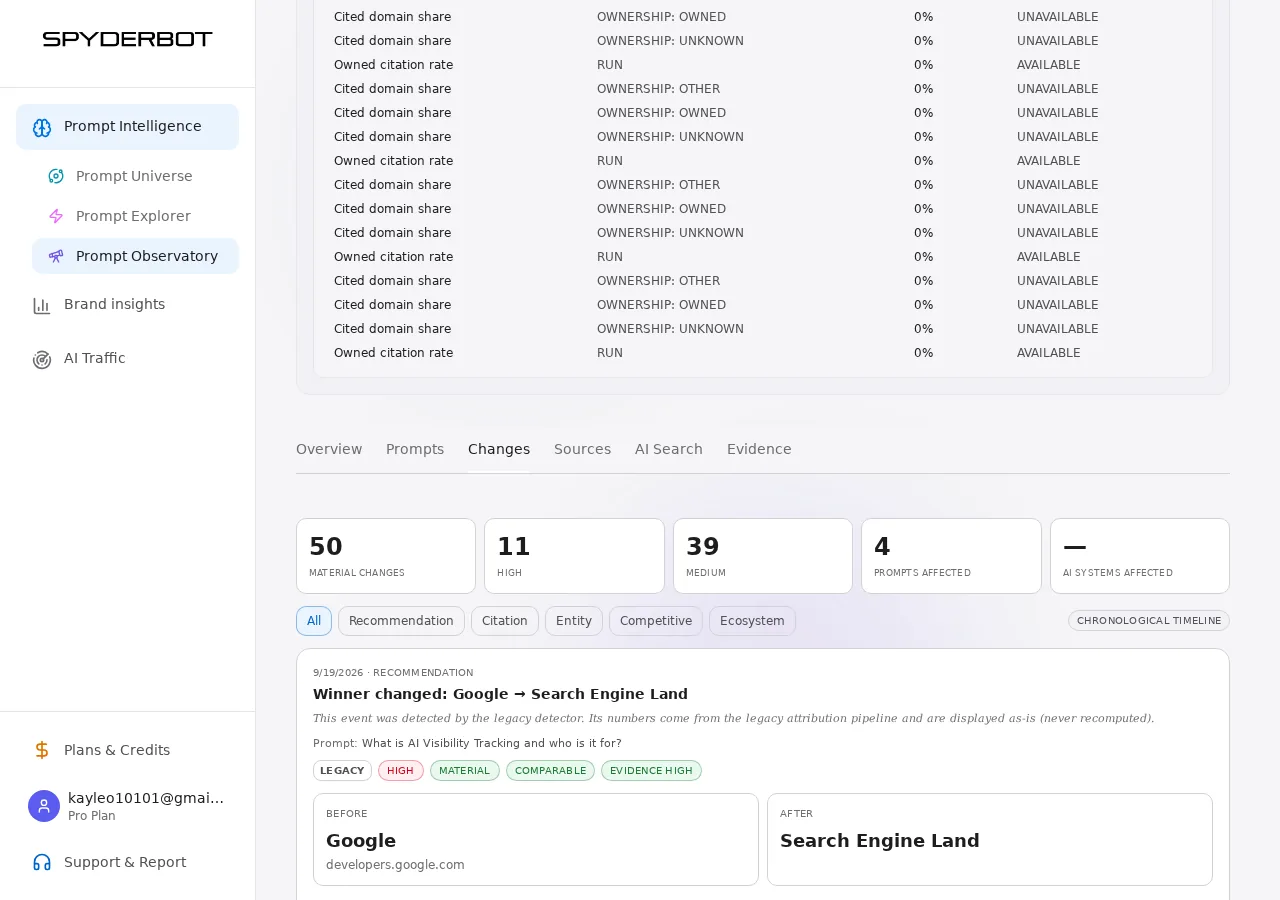
Use Scope & Persistence and relevant breakdowns. Determine whether the change concerns one question, a cluster, one AI system, or a broader observed pattern.
Where Measured Contributors are available and valid, use them to see which segment accounts for the measured movement. Contributions describe the arithmetic of the change; they do not establish its cause. Do not add contributions from different dimensions, such as questions and systems, as if they were independent parts of the same total.
If one system accounts for the relevant movement, keep the investigation focused there. If a pattern appears only once, consider whether its significance warrants immediate action or another observation. A verified serious factual error can justify correction even before a persistent trend is established.
4. Test the suggested explanation
Read Change Drivers, then open the evidence that could confirm or challenge the proposed explanation. Compare the relevant earlier and later response passages or source items.
Look for the actual change in behavior: a competitor is recommended under a different requirement; a capability is now described incorrectly; cited sources changed; or the answer introduces a new limitation.
Keep the strength of the explanation visible. A supported observed pattern is different from an indicative association, and an unresolved driver can remain unresolved. A source appearing at the same time as a recommendation change does not by itself prove the source caused it.
5. Choose a response proportional to the finding
| Supported finding | Next action |
|---|---|
| A product claim became inaccurate | Verify the fact and follow the portrayal playbook. |
| A competitor gained preference for a relevant requirement | Investigate the competitive gap and product fit. |
| Source evidence changed around a relevant claim | Inspect the specific sources and available content. |
| A positive pattern persists in the relevant scope | Identify what is now represented well; consider a bounded follow-up opportunity. |
| Movement is narrow, uncertain, or unexplained | Monitor with an explicit review trigger or run a focused investigation. |
| Measurement changed or failed | Resolve measurement before assigning a content task. |
Illustrative example. A brand's recommendation result declines. Observatory localizes the movement to integration questions in one system. Responses now prefer a competitor because they describe the brand's integration as manual. The team verifies the actual capability and investigates the public information behind that claim.
The team's conclusion is "a recommendation decline in this integration scope, associated with an inaccurate capability description." It does not claim that the whole brand has lost visibility or that a specific source caused the decline without evidence.
Finish with a decision note
Change: what moved, between which observations.
Scope: where the pattern occurs and how persistent it appears.
Explanation: what evidence supports, and what remains unresolved.
Response: action, targeted investigation, monitoring, or measurement repair.
Owner and checkpoint: who acts and what will be reviewed next.
You are done when the change has a scoped response. You do not need a complete causal explanation to assign a verified correction or a focused investigation, but you should not invent one to make the report sound complete.